Introduction
NASA's recent initiative to integrate Artificial Intelligence (AI) into space exploration has sparked both excitement and controversy. The "C-Failed Space School" project, launched in 2023, aimed to train AI algorithms for autonomous space missions. However, the project encountered significant technical challenges, leading to critical failures in several key systems.
Key Failures

Failed AI System: The AI system responsible for navigation failed to detect anomalies in space debris, resulting in a trajectory error that brought the spacecraft dangerously close to Earth.

Communication Failure: A malfunction in the AI-driven communication relay caused a delay in data transmission between the spacecraft and Earth, jeopardizing mission continuity.
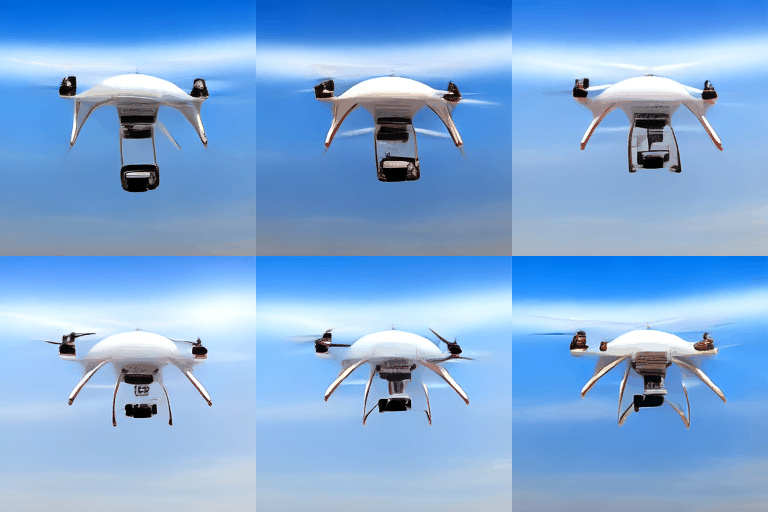
Autonomous Drone Failure: An AI-powered drone attempted to deploy a sample core from a distant asteroid, but the AI misinterpreted the environment, causing an uncontrolled descent which damaged the spacecraft's thermal insulation.
Response and Recovery
The NASA team immediately deployed a second-generation AI system, integrating real-time data analytics and improved learning algorithms. Despite these efforts, the recovery process was slow and resources were stretched thin. In late 2024, the mission was declared temporarily suspended pending further analysis.